The Foreign Service Benefit Plan Premium Shock: Is It Time to Reconsider Your Health Insurance Strategy?
The release of the 2027 FEHB premiums has sparked an unusually active conversation among Foreign Service families. The reason is easy to understand: the Foreign Service Benefit Plan (FSBP) is expected to experience a substantial increase in its Self Plus Family premium.
For many households, that increase may be large enough to justify reviewing available health insurance options during Open Season.
One alternative receiving increased attention is the GEHA High Deductible Health Plan (HDHP). While high-deductible plans are often viewed through the lens of lower premiums, the comparison is more nuanced than that. The GEHA HDHP also includes access to a Health Savings Account (HSA), which introduces additional financial and tax considerations that can materially affect long-term outcomes.
Open Season runs from November 9 through December 14 this year, giving families a limited window to evaluate whether remaining in FSBP or moving to another plan better aligns with their needs.
What Is Changing?
Foreign Service Benefit Plan (FSBP)
In 2026, Self Plus Family coverage under FSBP costs approximately $248.27 per biweekly paycheck, or $537.93 per month for annuitants.
For 2027, that premium is expected to rise to approximately $382.65 per paycheck, or $829.08 per month for annuitants.
That represents an increase of approximately 54%: $134.38 per paycheck, or approximately $3,493.88 annually for employees paid biweekly.
GEHA HDHP
In 2026, the GEHA HDHP premium is approximately $215.63 per biweekly paycheck, or $467.19 per month for annuitants.
Based on currently available OPM figures, the premium is not expected to increase in 2027.
For many Foreign Service households, this increase alone is significant enough to warrant a review of available alternatives.
Using the projected 2027 premiums, the GEHA HDHP would cost approximately $167 less per paycheck than FSBP, creating an annual premium difference of roughly $4,343 for an employee paid biweekly.
At first glance, that appears to make the decision straightforward. However, comparing health plans based solely on premiums can be misleading. Deductibles, out-of-pocket costs, prescription coverage, tax implications, and household cash flow all play important roles in determining which plan is ultimately the better fit.
Understanding the Role of an HSA
One reason the GEHA HDHP deserves serious consideration is its connection to a Health Savings Account.
HSAs are unique because they combine healthcare funding with powerful tax advantages. Contributions may be tax deductible, investment earnings can grow tax deferred, and qualified medical withdrawals are generally tax free.
In my planning work, I like to compare health plans by looking beyond annual premiums and considering the full financial picture. The HSA often becomes an important part of that analysis because it can serve multiple purposes.
Some households use the HSA strictly as a spending account for current medical expenses. Others pay healthcare costs from cash flow and leave HSA assets invested for years or even decades. In that scenario, the HSA can function as an additional tax-advantaged investment account.
Of course, that strategy is not appropriate for every family.
A high-deductible health plan generally requires households to absorb more healthcare costs earlier in the year. Families without sufficient emergency savings may find that cash-flow burden uncomfortable, even if the long-term math appears attractive.
As a result, evaluating an HDHP involves more than calculating potential savings. It requires understanding whether the strategy aligns with the household's financial resources and risk tolerance.
How I Compare Health Plans
When comparing FSBP and the GEHA HDHP, I do not focus exclusively on premiums.
Instead, I evaluate a variety of factors that can influence the total financial impact of each option, including:
- Expected medical expenses
- Deductibles and out-of-pocket maximums
- HSA contributions and employer funding
- Potential investment growth inside the HSA
- Federal and state income taxes
- Medical inflation
- Prescription drug costs
- Specialist visits
- Hospitalization and maternity benefits
- Overseas and foreign healthcare needs
- Household cash reserves
- Risk tolerance
The outcome can vary substantially from one family to another. A plan that works exceptionally well for one household may be a poor fit for another with different healthcare utilization patterns or financial circumstances.
Five-Year Illustration: Comparing the Plans
To better understand the tradeoffs, I created a five-year comparison using a set of moderate healthcare spending assumptions.
Under those assumptions, a household selecting the GEHA HDHP and making effective use of the available premium savings and HSA benefits ends the five-year period approximately $35,143 ahead in overall net worth.
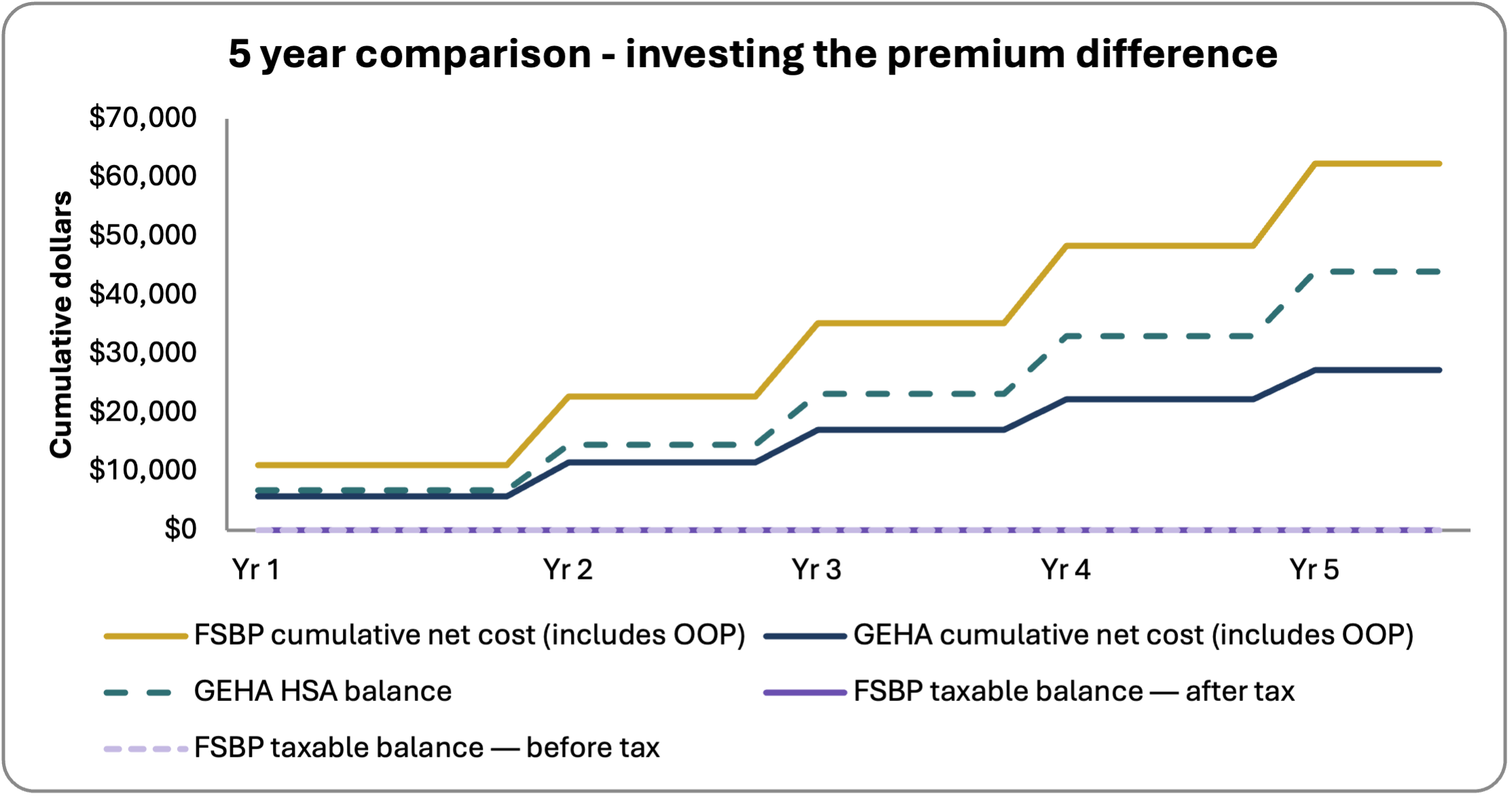
That result may seem compelling, but it comes with an important caveat.
The projected advantage is partially achieved by accepting greater exposure to upfront healthcare costs. In the first year of the illustration, estimated out-of-pocket medical expenses rise from approximately $1,140 under FSBP to roughly $3,720 under GEHA.
That difference of approximately $2,580 highlights an important reality: lower premiums do not necessarily mean lower healthcare costs throughout the year.
Unexpected hospitalizations, injuries, or other major medical events could affect the outcome. Therefore, any comparison should consider not only projected long-term results, but also the household's ability to manage potentially higher expenses earlier in the year.
Five-Year Illustration: HSA Versus Taxable Investing
A second illustration examines a different question.
Suppose a household chooses the GEHA HDHP, maximizes HSA contributions, and invests those assets. How might that compare with staying in FSBP and investing a comparable amount in a taxable brokerage account?
Using the assumptions in this illustration, the HSA accumulates approximately $59,720 after five years, while the taxable account grows to approximately $36,230.
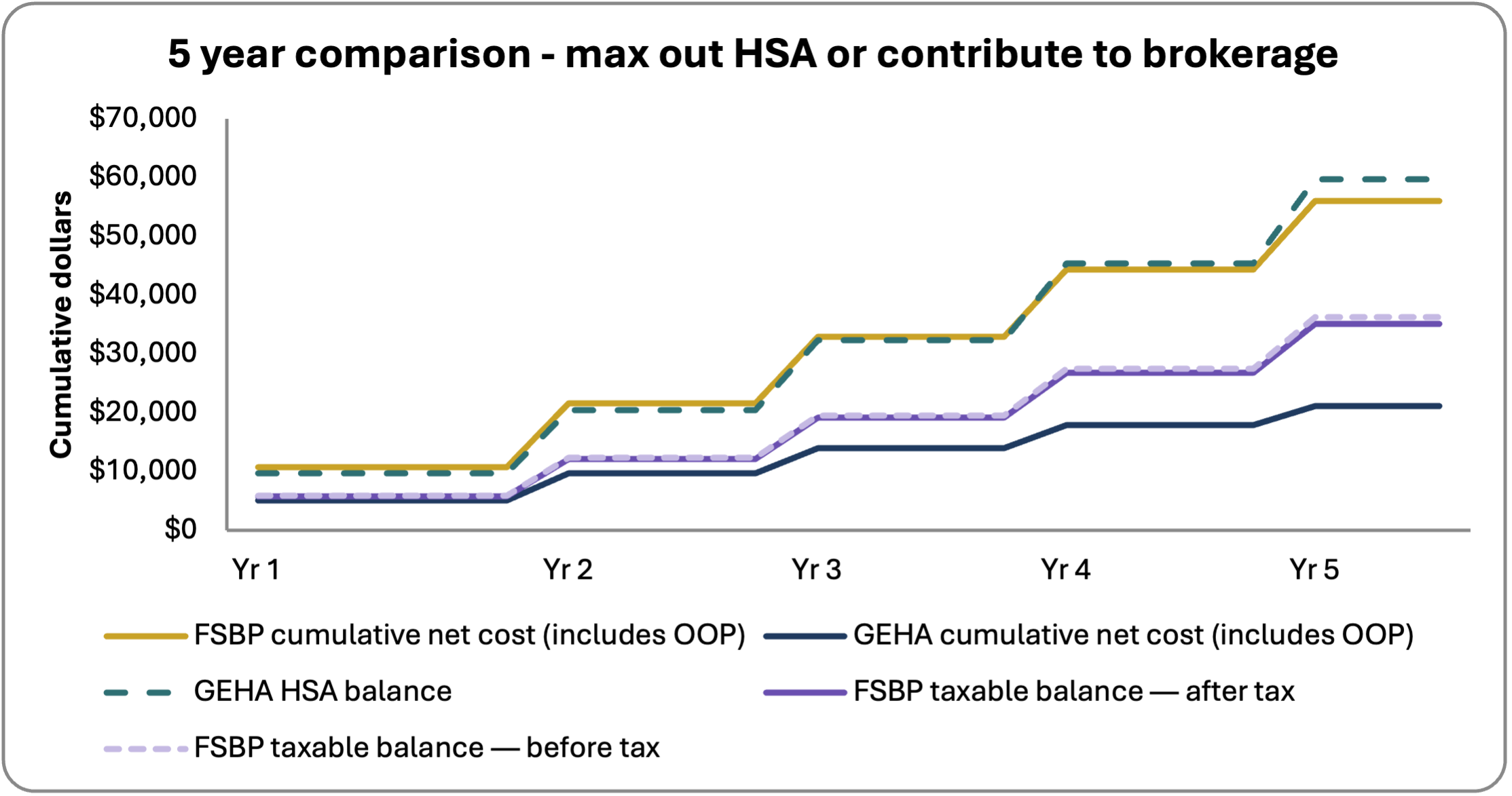
The difference is primarily driven by the tax advantages associated with HSA contributions and growth.
However, these results remain hypothetical. Actual outcomes will depend on future investment returns, tax rates, healthcare expenses, contribution levels, and how the funds are ultimately used.
Want articles like this straight to your inbox?
Unsubscribe anytime. By subscribing you agree to our privacy policy.
The Real Question: Which Plan Fits Your Household?
The discussion ultimately extends beyond premiums, investment projections, or even HSAs.
Selecting a health insurance plan is a balancing act between financial efficiency and predictability.
Some households prioritize minimizing long-term costs and are comfortable accepting greater short-term variability. Others place a higher value on predictable healthcare expenses and reduced financial uncertainty.
Families expecting significant healthcare utilization may find that richer coverage and lower out-of-pocket exposure justify higher premiums. Likewise, larger households, particularly those with active children involved in sports or other physically demanding activities, may appreciate the peace of mind that comes from having a more manageable deductible.
An HDHP can be an excellent option for families with adequate reserves and a willingness to manage the additional complexity of an HSA. For others, the predictability offered by traditional coverage may outweigh the potential financial benefits.
The best answer is not necessarily the plan with the lowest premium or the highest projected net worth. It is the plan that fits the household's overall financial situation, healthcare needs, and comfort with risk.
Open Season is one of the few opportunities federal employees and retirees have each year to revisit that decision. With premiums changing significantly in 2027, this may be one of the more important Open Season evaluations many Foreign Service families have faced in recent years.
This article is for educational purposes only and does not constitute personalized investment, tax, or legal advice. The five-year illustrations are hypothetical, are based on the assumptions shown in each graph, and do not represent actual client results. Individual circumstances vary, and readers should consult a qualified professional before making financial decisions.